What is SEO and why does it matter for new websites? If you’re launching a blog or website in 2026, understanding SEO can be the difference between getting traffic and staying invisible.
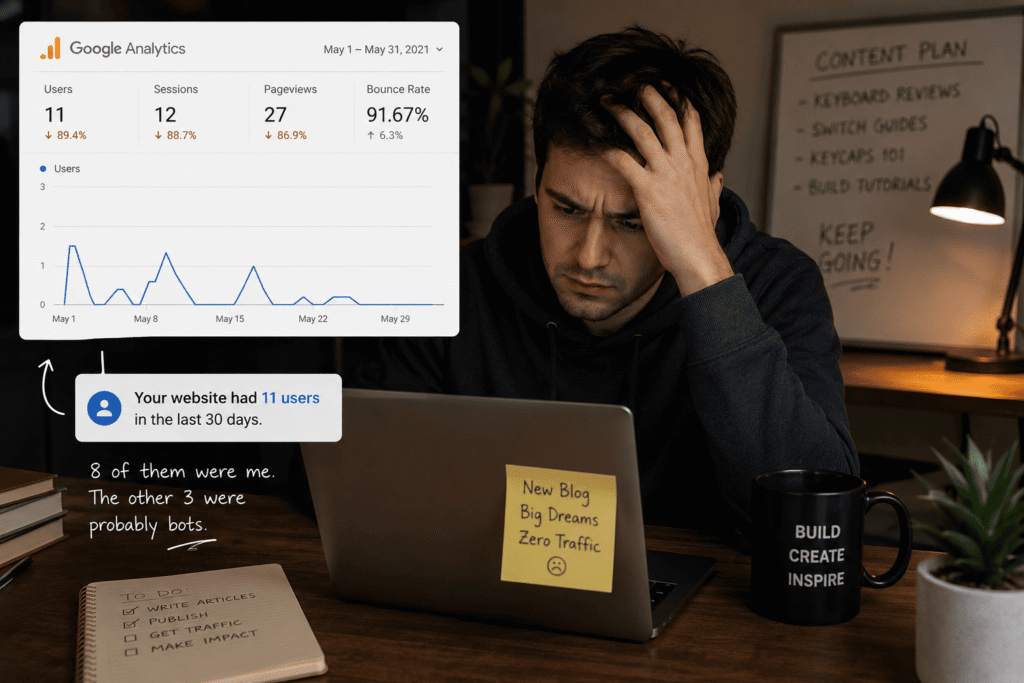
Let me take you back to 2021. I had just launched my first niche blog — a site about budget mechanical keyboards. I spent three weeks writing what I genuinely believed were the best articles on the internet about switch types, keycap materials, and starter builds.
Then I hit publish. And waited. And checked Google Analytics every five minutes like a nervous parent waiting outside an exam hall.
The result? Eleven visitors in the first month. Eight of them were me. The other three were probably bots.
Nobody told me about SEO. Or more accurately, I assumed SEO was some dark art that big brands paid agencies thousands of dollars for — something that didn’t apply to a one-person blog about keyboards. That assumption cost me about six months of wasted traffic.
If you’re building a new website right now and you’re in that same spot — excited, publishing content, but getting zero traction — this one’s for you. I’m going to explain what SEO actually is, why it matters more for new websites than for established ones, and what to actually do about it without losing your mind.
So what even is SEO?
SEO stands for Search Engine Optimization. But that phrase sounds more complicated than it needs to be.
Here’s a simpler way to think about it: when someone types something into Google (or Bing, or DuckDuckGo, or wherever), a long list of results appears. SEO is the process of making sure your website shows up in that list — and ideally, shows up near the top.
SEO isn’t about tricking Google. It’s about making your content so clear and helpful that Google has no reason not to recommend it.
Search engines like Google use automated programs called “crawlers” or “spiders” to browse the web. They read your pages, figure out what your content is about, and then decide how relevant and trustworthy your site is for various search queries. That decision is made by an algorithm — a set of rules that ranks pages based on hundreds of different signals.
SEO is essentially the practice of aligning your website with what those signals are looking for. That includes things like: how well-written and relevant your content is, how fast your site loads, how many other reputable websites link to you, whether your website works properly on mobile, and a bunch of other stuff we’ll get into.
Why new websites specifically need to care about this
Here’s something that experienced web builders know and beginners almost never do: Google doesn’t trust new websites by default.
Think of it like being new to a city. You don’t know anybody, nobody knows you, and you have no track record. Even if you’re brilliant at what you do, it takes time to build credibility. Google works the same way.
Established websites — the ones that have been around for years, have lots of content, and have earned links from other respected sites — rank easily. A new website starts from scratch with zero domain authority, zero backlinks, and zero trust signals.
This is why SEO matters more at the beginning than at any other point. The decisions you make in the first few months of a website’s life — the structure you set up, the content you write, the keywords you target — create the foundation that everything else gets built on. Getting these wrong means you’re playing catch-up for a long time. Getting them right means you can grow organically without spending a dollar on ads.
I didn’t get them right. So I learned the hard way. You don’t have to.
The four main pillars of SEO
SEO breaks down into four broad areas. Most beginners focus on just one (usually content) and neglect the others. That’s like building a table with one leg.
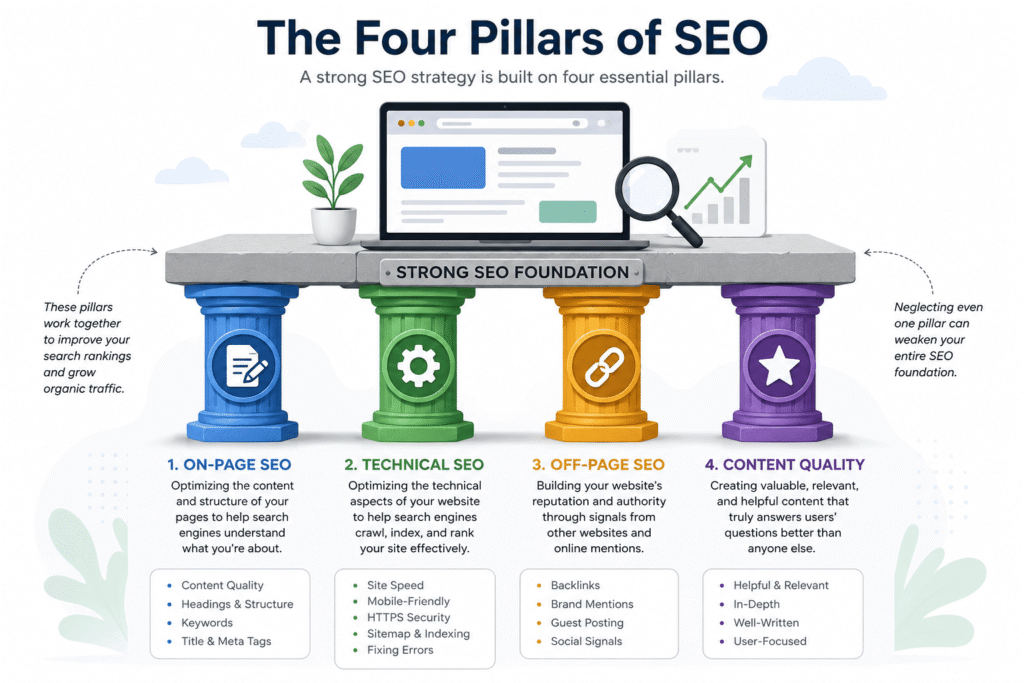
1. On-page SEO — what’s on your actual pages
This covers everything that lives on your website: the words you write, the headings you use, the way you structure your articles, your page titles, your meta descriptions (the little preview text that appears under your link in search results), and how you use keywords naturally throughout your writing.
For my keyboard blog, I was writing things like “best mechanical keyboard” over and over because I thought repetition = SEO. It doesn’t. It actually works against you. Google has gotten very good at detecting that kind of stuffing and it penalizes sites that do it.
2. Technical SEO — how your site is built
This is the stuff happening under the hood. Does your site load quickly? Is it mobile-friendly? Does it use HTTPS? Can Google’s crawlers actually access and read your pages? Is there a sitemap? Are there any broken links? Do your pages accidentally duplicate each other?
Technical SEO sounds intimidating but most of it gets handled automatically if you’re using a decent platform like WordPress with a good theme, or Webflow, or Squarespace. The things to watch out for are slow page speeds (check with Google’s free PageSpeed Insights tool) and making sure you haven’t accidentally blocked search engines in your settings.
3. Off-page SEO — your reputation around the web
The biggest factor here is backlinks — when other websites link to yours. Think of each link as a vote of confidence. A link from a well-known, respected site carries a lot more weight than a link from a random low-quality blog.
For new sites, this is usually the hardest pillar to build. You can’t just go buy links (well, you can, but Google actively punishes that practice). You earn them by creating content that’s genuinely worth linking to, by getting mentioned in your industry, by guest posting on established blogs, by building relationships with other creators.
4. Content quality — the foundation everything rests on
All the technical tricks in the world won’t save you if your content is thin, vague, or unhelpful. Google’s entire business model depends on giving users the best possible answers. If your content genuinely answers questions better than anyone else, Google eventually figures that out and rewards it.
“Eventually” is doing a lot of work in that sentence, by the way. It can take three to six months for a new page to rank — sometimes longer. That’s the reality, and it’s one of the hardest things to accept when you’re starting out.
A practical step-by-step starting point for new sites
This is what I wish someone had walked me through from day one:
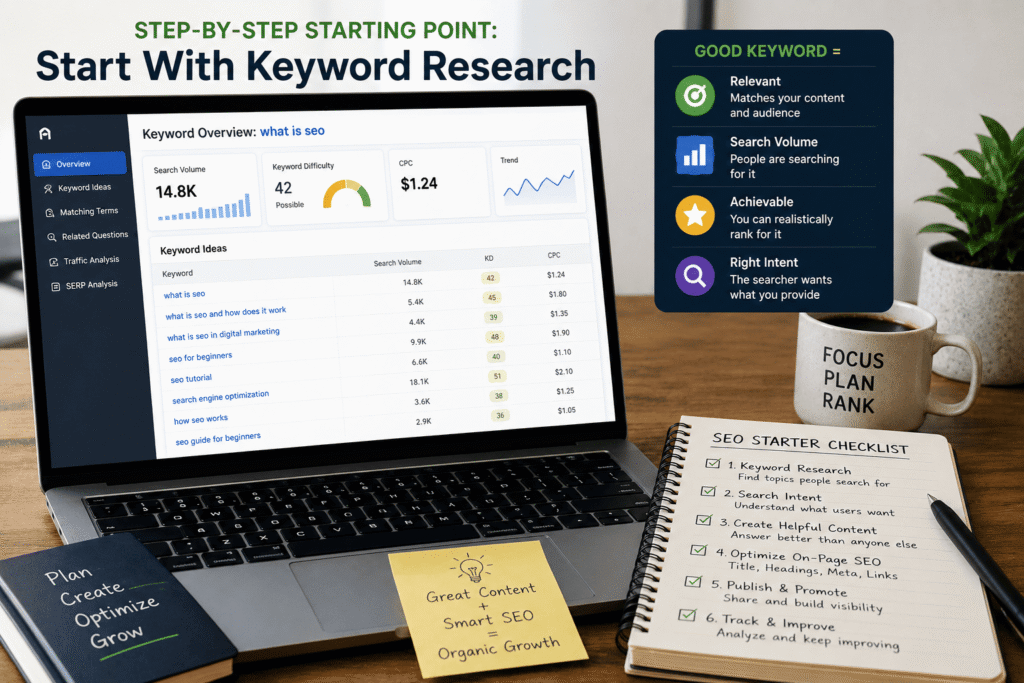
- 1Start with keyword research before you write anything. Use a free tool like Google Search Console (after you launch), Ubersuggest, or the free version of Semrush. Find out what actual phrases people are typing into Google that relate to your topic. Target lower-competition keywords first — especially “long-tail” phrases like “best mechanical keyboard under $100 for beginners” rather than just “mechanical keyboard.”
- 2Set up Google Search Console immediately. It’s free, it’s made by Google, and it tells you exactly how your site is performing in search — which queries bring visitors, which pages are getting impressions, whether there are any technical errors. There’s no good reason not to use it.
- 3Install an SEO plugin or tool. If you’re on WordPress, Rank Math or Yoast SEO handle a lot of the technical basics for you and give you real-time feedback as you write. If you’re on another platform, most have built-in SEO fields — fill them all in.
- 4Structure your content properly. Use one H1 heading (your main title), then H2s and H3s to organize sections logically. This helps both Google and human readers navigate your page. Write naturally — include your target keyword in the title, in the first paragraph, and a few more times where it genuinely fits.
- 5Build internal links between your own pages. When you write a new article, link to relevant older articles. This helps Google understand the structure of your site and helps readers explore more of your content. It’s one of the easiest, most overlooked tactics beginners skip entirely.
- 6Prioritize page speed. Compress your images before uploading them (use something like Squoosh, which is free and browser-based). Avoid loading a dozen unnecessary plugins. A site that takes six seconds to load loses visitors before they’ve even read a word.
- 7Be consistent. One well-researched article per week beats ten mediocre posts in a rush. Google rewards consistency and depth. Pick a sustainable pace and stick to it.
Tools worth knowing about
Google Search Console
Free. Essential. Shows you exactly how Google sees your site.
PageSpeed Insights
Free Google tool. Tells you how fast your pages load and what to fix.
Ubersuggest
Freemium. Good for keyword research when you’re just getting started.
Ahrefs / Semrush
Paid (but powerful). Best for competitive analysis and backlink research once you’re ready to go deeper.
Rank Math
WordPress plugin. Handles on-page SEO guidance as you write. Free tier is very capable.
Squoosh
Free browser tool. Compress images before uploading to keep your site fast.
Mistakes I made (and see beginners make constantly)
- ✕Targeting keywords that were way too competitive. Writing about “best laptop” when you’re a brand-new site is basically pointless. A thousand established sites already dominate that term. Start with specific, lower-volume topics where you can actually compete.
- ✕Ignoring the technical side completely. I had duplicate pages because my site was generating a www. and non-www. version of every URL. Google was splitting its attention between two versions of every page. Simple fix once you know about it — but I didn’t know for months.
- ✕Publishing thin content. My early articles were 400-500 words. They didn’t go deep on anything. Modern SEO strongly rewards comprehensive, authoritative content that actually answers every question a reader might have. Short and shallow rarely competes.
- ✕Never building any backlinks. I assumed good content would automatically get links. It doesn’t — at least not in the early days. You have to actively introduce your content to people, communities, and websites that might care about it.
- ✕Expecting results in two weeks. SEO is slow. A new website in a reasonably competitive space should expect to wait at least three to six months before seeing meaningful organic traffic, even while doing everything right. Anyone promising faster results is probably selling something.
- ✕Chasing algorithm updates instead of the reader. Every few months there’s a Google algorithm update and the SEO community panics. I wasted time trying to reverse-engineer every update instead of just focusing on what genuinely helps readers. Sites that focus on real helpfulness tend to survive algorithm changes; sites built on manipulation get wiped out by them.

A quick word on AI and SEO right now
Can’t write an SEO article in 2026 without addressing the elephant in the room. AI-generated content has flooded the web, and Google has responded by leaning even harder into what it calls E-E-A-T: Experience, Expertise, Authoritativeness, and Trustworthiness.
The single biggest differentiator you have as a new site owner is genuine first-hand experience. If you’ve actually used the thing you’re writing about, tested the product, lived through the situation — that comes through in your writing, and Google increasingly rewards it. An article written by someone who spent a weekend genuinely testing five different keyword tools beats a generic overview every time.
Use AI as a research and drafting assistant by all means. But the experience, the opinions, the specific details from real use — those need to come from you.
Where to go from here
If you’re just launching a new website, the most important thing you can do right now is not to read every SEO guide ever written and try to implement everything at once. That’s how you end up paralyzed and publishing nothing.
Start with three things: set up Google Search Console, do basic keyword research before your next article, and make sure your site actually loads quickly on a mobile phone. Those three alone will put you ahead of a significant chunk of new websites out there.
SEO isn’t a trick you apply once. It’s a mindset you develop over time — one where you’re always thinking about who’s searching for what you’re writing, and whether you’re giving them the best possible answer. Get that habit down early and the rest of it becomes a lot more intuitive.
It took me about a year to go from eleven monthly visitors to over 12,000. Boring answer, but: consistent content, basic technical hygiene, and actually helping readers. That’s it.