
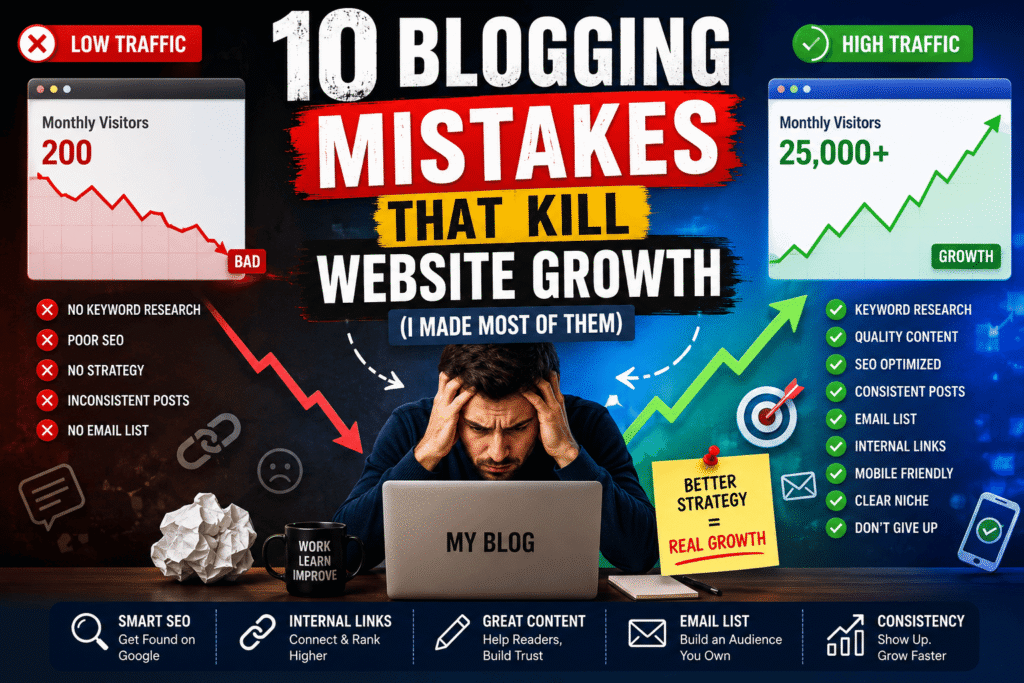
“I published 60 posts in my first year. My traffic after 12 months? About 200 visitors a month. I thought I was doing everything right. Turns out, I was doing almost everything wrong.”
That was me in 2021, running a tech review blog I was genuinely excited about. I had the enthusiasm, I had the time, and I had absolutely no idea what I was doing wrong. The blog looked fine. The writing was decent. But nothing was growing.
It wasn’t until I did a deep audit — using tools like Ahrefs, Google Search Console, and just reading a lot of posts from people who actually knew what they were doing — that I started seeing the patterns. And honestly? Most of the mistakes were embarrassingly fixable.
If you’re a blogger wondering why your traffic is flat, your bounce rate is high, or your posts just seem to disappear into the void, this one’s for you. Here are the 10 mistakes that kill blogs — and how to actually fix them.
Mistake 01
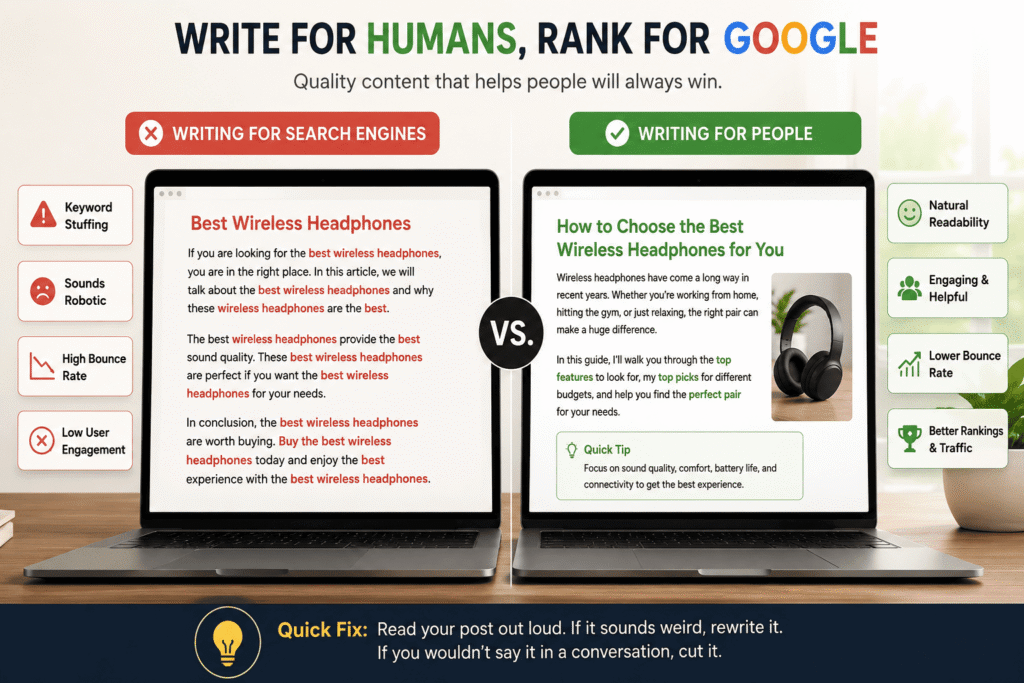
Writing for Search Engines, Not People
I used to stuff my target keyword into literally every other paragraph. “Best wireless headphones.” “The best wireless headphones.” “If you’re looking for the best wireless headphones…” It read like a legal document written by a robot.
Here’s the thing — Google has gotten incredibly good at detecting when you’re writing for bots instead of humans. And even if you rank, visitors will bounce off your page in seconds if it’s painful to read.
Write like you’re explaining something to a friend who’s smart but not an expert. Use your keyword naturally. Mention related terms. Focus on actually answering the question someone typed into Google.
Quick fix: Read your post out loud. If it sounds weird, rewrite it. If you wouldn’t say it in a conversation, cut it.
Mistake 02
Ignoring Keyword Research Entirely
For my first 40 posts, I just wrote whatever I felt like writing. “Why I Love My Standing Desk.” “A Day in My Home Office.” Sweet content. Zero traffic. Because literally no one was searching for those exact things.
Keyword research isn’t about gaming the system — it’s about finding out what questions real people are already asking, and then writing the best possible answer. Tools like Google’s free “People Also Ask” section, Ubersuggest, or even just typing a half-sentence into Google and watching the autocomplete suggestions are a great starting point.
For more serious research, Ahrefs and SEMrush are worth it if you’re committed. But even free tools like Keywords Everywhere (a Chrome extension) can change how you think about topics.
Quick fix: Before writing any post, search your topic on Google. Look at what’s already ranking. Ask yourself: can I write something genuinely better or different?
Mistake 03
Publishing and Forgetting
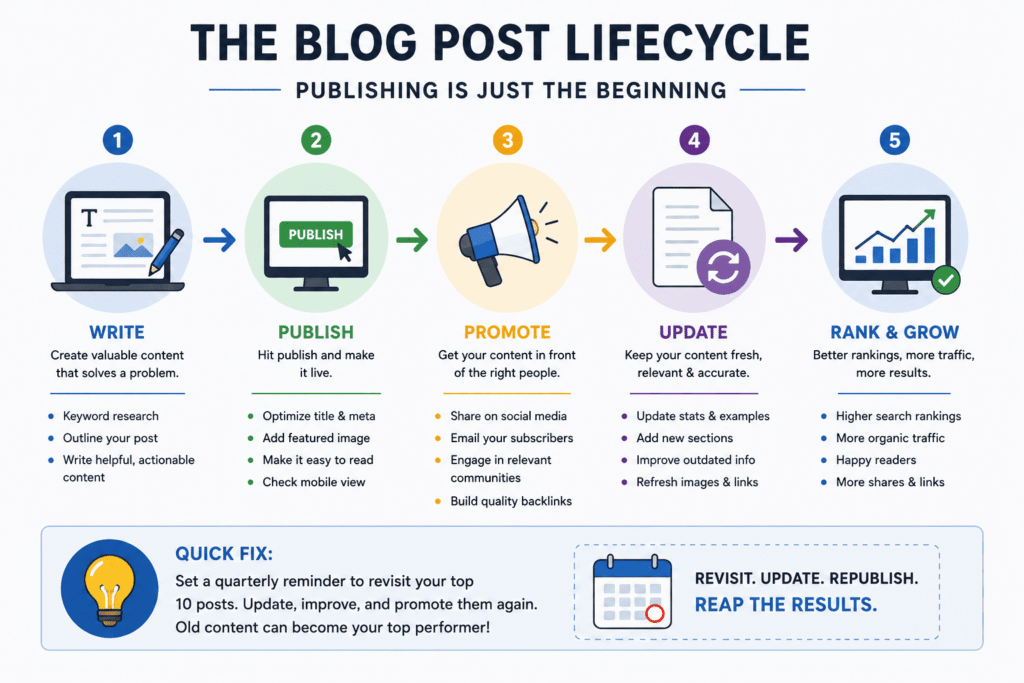
This one hurt when I realized it. I thought hitting “Publish” was the finish line. It’s actually closer to the starting pistol.
Most blog posts don’t rank well right out of the gate. Google needs time to index them, understand them, and see how users interact with them. Meanwhile, your job is to promote that post — share it in relevant Facebook groups or Reddit threads (without being spammy), link to it from newer posts you write, maybe pitch it to a few newsletters in your niche.
And then, a few months later? Go back and update it. Add new information. Fix anything outdated. Google loves freshness signals, and you’ll often see a ranking jump just from updating old content.
Quick fix: Set a quarterly reminder to revisit your top 10 posts. Update stats, refresh examples, add new sections based on what people are asking in comments or forums.
Mistake 04
Terrible Post Titles (The Click-Through Killer)
I had a post titled “Thoughts on Note-Taking Apps.” It covered Notion, Obsidian, Roam Research, and Evernote in solid depth. Know what it got? Almost nothing. I changed the title to “Notion vs. Obsidian vs. Evernote: Which Note-Taking App Actually Wins in 2026?” Traffic went up noticeably within a few weeks.
Your title is the first thing someone sees in search results. If it doesn’t give them a reason to click, nothing else matters. Specificity works. Numbers work. Addressing a real pain point works. Vague and clever usually doesn’t.
Use CoSchedule’s Headline Analyzer or even just ChatGPT to brainstorm 10 title variations and pick the strongest one. It sounds like a small thing. It is not a small thing.
Quick fix: Go check your lowest-traffic posts. Rewrite their titles to be more specific, more useful, or to include a number or comparison. A/B test in Google Search Console.
Mistake 05
No Internal Linking Strategy
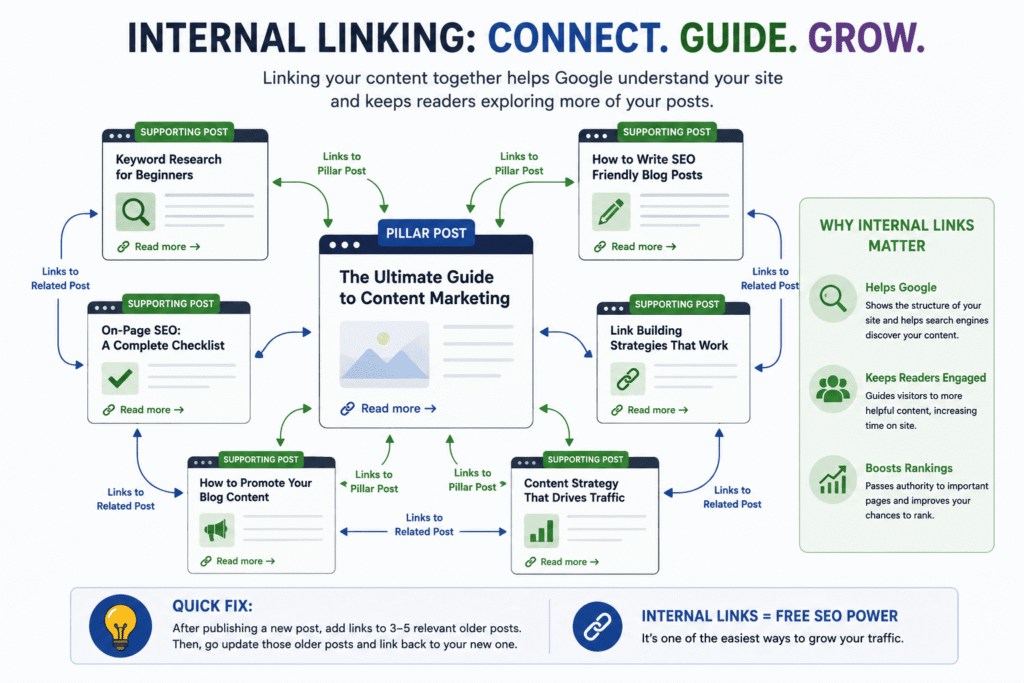
Internal links are basically free SEO, and most bloggers leave them completely on the table. When you write a new post, you should be thinking about which existing posts it can link to — and which existing posts you should go back and add a link to this new one from.
This does two things: it helps Google understand the structure and depth of your site, and it keeps readers exploring more of your content instead of bouncing away after one post. I started using a simple spreadsheet to track my post topics and see which ones were related, and my average session duration went up visibly within a month.
Quick fix: After writing every new post, go to 3–5 old posts on related topics and add a contextual link to the new one. It takes 10 minutes and makes a real difference.
“The blogs that grow aren’t necessarily the ones with the best writing. They’re the ones where the writer keeps showing up, keeps learning, and keeps fixing what isn’t working.”
Mistake 06
Skipping the Email List (Your Biggest Mistake)
I waited two years before starting an email list. Two years. That’s probably the single most expensive mistake I made as a blogger. Not money — time. Every post I published during those two years had no direct channel to readers. When I finally set up a simple opt-in form using ConvertKit (now renamed Kit) with a free resource as an incentive, I started building something I actually owned.
Social media algorithms change. SEO rankings fluctuate. Your email list is the one audience channel that you control entirely. Even a list of 500 engaged subscribers is worth more than 10,000 passive Twitter followers for driving traffic to a new post.
Quick fix: Set up a free account on Kit, Mailchimp, or MailerLite today. Offer something simple — a checklist, a resource guide, a mini email course — in exchange for a signup. Put the opt-in form at the end of every post.
Mistake 07
Posting Whenever, However — No Consistency
For a while, I’d publish four posts in one week when I felt inspired, then disappear for six weeks. This is terrible for a few reasons. Google’s crawl frequency partly depends on how often you publish new content. Your readers (if you have any) get confused about when to expect new stuff. And you personally get no momentum or rhythm.
You don’t need to post every day. Honestly, one solid post per week or even two per month beats erratic publishing. What matters is showing up consistently. Pick a realistic schedule — even if that’s just twice a month — and stick to it like it’s a work meeting.
Quick fix: Use Notion or Trello to build a simple editorial calendar. Plan topics 6–8 weeks ahead so you’re never scrambling for ideas at the last minute.
Mistake 08
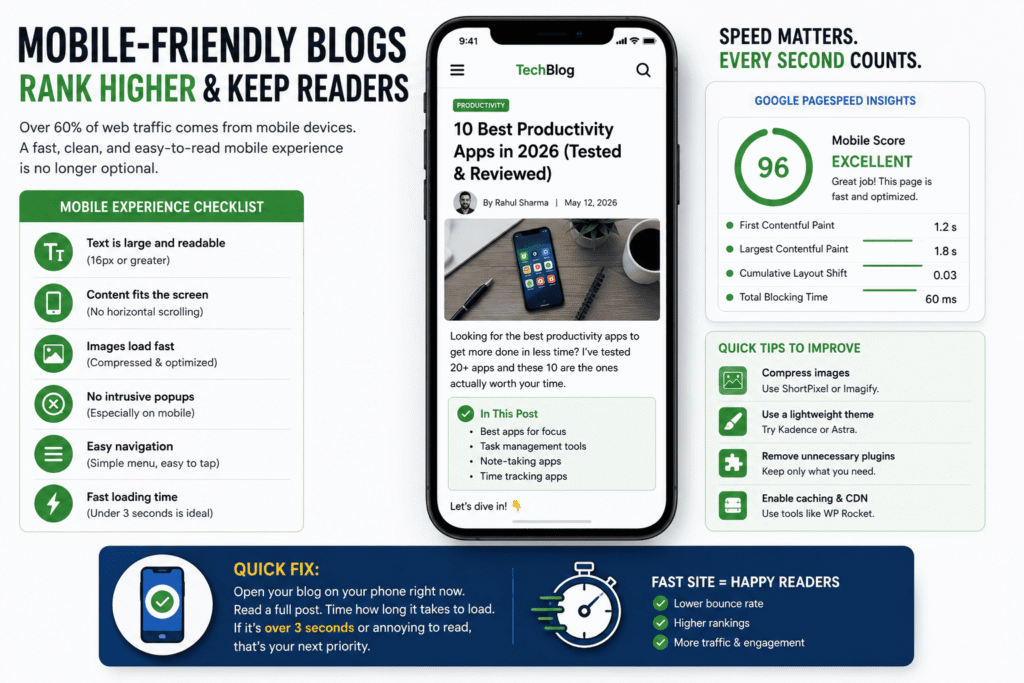
A Mobile Experience That’s Basically Torture
Over 60% of web traffic comes from mobile devices. If your blog is hard to read on a phone — tiny text, popups that cover the whole screen, images that take forever to load — you’re hemorrhaging readers.
I tested my own blog on a cheap Android phone one day and was genuinely embarrassed. My sidebar was covering content. My font was 13px. A newsletter popup appeared 2 seconds after landing. No wonder my bounce rate was nearly 80%.
Use Google’s PageSpeed Insights to check your load time and core web vitals. Install a lightweight WordPress theme (Kadence and Astra are both fast and free). Compress your images with ShortPixel or Imagify. Get rid of unnecessary plugins.
Quick fix: Open your blog on your phone right now. Read a full post. Time how long it takes to load. If it’s over 3 seconds or annoying to read, that’s your next priority.
Mistake 09
Writing About Everything — Standing for Nothing
A blog about productivity, travel, recipes, personal finance, and book reviews is not a niche — it’s a diary. And while diaries are great, they’re not great for growing an audience or ranking in search.
When your blog is tightly focused, a few things happen: Google understands your topical authority, readers know what to expect from you, and you become the go-to resource in your corner of the internet instead of a generalist nobody remembers.
This doesn’t mean you have to be robotic about it. You can write about adjacent topics. But there should be a clear through-line — a clear answer to “who is this blog for and what problems does it solve?”
Quick fix: Write one sentence that finishes this: “My blog helps [specific type of person] do [specific thing].” If you can’t do it in one sentence, your niche might be too broad.
Mistake 10
Quitting Right Before Things Start Working
Blogging has what people in the industry call the “sandbox period” — a phase (often 6 to 12 months) where Google is essentially evaluating whether your site is worth ranking. During this period, you might publish 30 quality posts and get almost no organic traffic. It looks like failure. For most people, it is when they quit.
But if you push through it with consistent, quality content and basic SEO practices, growth often happens suddenly — not gradually. You plateau for months, then one day your traffic doubles in a week because three posts started ranking simultaneously. I’ve seen this happen to my own blog and to dozens of others I’ve watched over the years.
Quick fix: Commit to a minimum of 12 months before evaluating whether blogging “works” for you. Track your progress in Google Search Console weekly — impressions usually start growing before clicks do, which is an early positive signal.
One Last Thing
Fixing all of this at once isn’t realistic. Pick the two or three mistakes that resonate most with where you are right now, and fix those first. Then come back to the rest.
The blogs that grow aren’t always the ones with the most talent or the biggest budgets. They’re usually the ones run by someone who paid attention to what wasn’t working and kept adjusting. That’s the actual secret — not some algorithm hack or viral moment.
If you’ve been grinding away on your blog with little to show for it, the odds are good that your content is better than your strategy. The good news is that strategy is completely learnable. Start small. Fix one thing. Then fix another.
You’ve got this.