A few years back, I spent almost three months “getting ready” to start a blog. I picked a niche, switched niches, bought a domain, changed it, read seventeen tutorials, and still hadn’t written a single post. Turns out I was procrastinating wrapped in the feeling of productivity.

When I finally launched — just a barebones WordPress site, three posts, and a rough logo I made in Canva — something clicked. The feedback loop from actual readers taught me more in two weeks than all that research did in three months. So this guide skips the fluff and gets to what actually matters in 2026.
Is blogging still worth it in 2026?
Fair question. AI content is everywhere. SEO feels like it changes every other week. And everyone seems to have a newsletter now. But here’s the honest reality: the noise is actually an opportunity.
Most AI-generated blogs are generic, thin, and forgettable. A blog with a real voice — your takes, your experience, your specific knowledge — stands out more now than it did five years ago. Google’s own Helpful Content updates have been hammering thin, mass-produced content. Specific, experience-based writing is what’s surviving and growing.
So yes. Worth it. But only if you approach it the right way.
Step 1: Pick a niche you actually know something about
Step 01
Choose your topic space
The sweet spot is something you know well enough to be helpful, narrow enough to not be vague, and broad enough to write 50+ posts about.
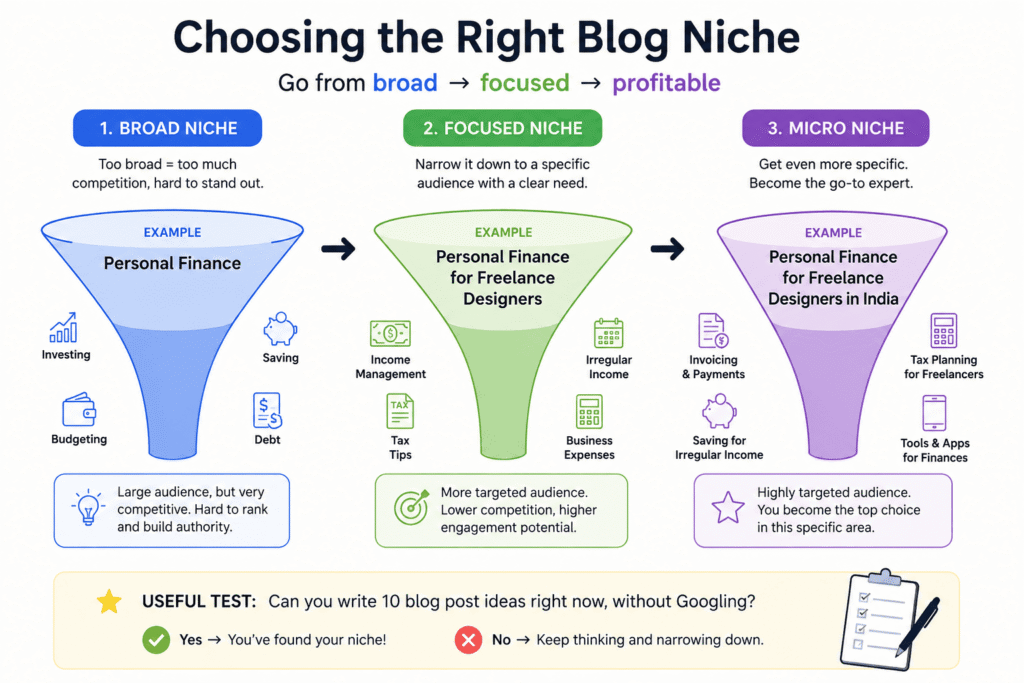
When I started my first blog, I chose “personal finance” — an enormous category. Getting any traction was near impossible. When I narrowed to “personal finance for freelance designers,” things got much easier. Smaller audience, but a loyal one.
A useful test: can you write ten post ideas right now, off the top of your head, without Googling? If yes, you’ve probably found your niche. If you’re staring at a blank page, keep thinking.
Don’t overthink the “passion vs. profit” debate either. The best niche is something you know deeply and don’t mind writing about consistently. You don’t have to love it. You just can’t hate it.
Step 2: Set up your blog (without overcomplicating it)
Step 02
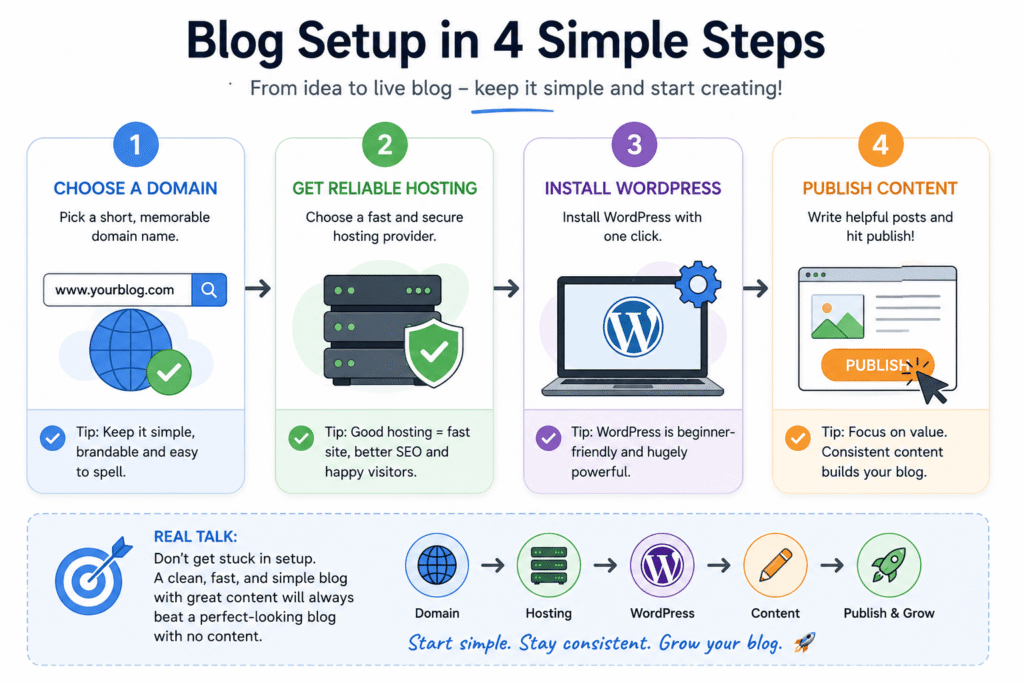
Platform, hosting, domain
Most people spend too long here. These decisions matter, but they’re also reversible. Pick something solid and move on.
In 2026, your realistic options for a self-hosted blog are WordPress.org, Ghost, and Webflow. Here’s a quick breakdown of what I’d pick for different situations:
Best for beginners
WordPress.org
Huge plugin ecosystem, easy themes, widely supported
Best for newsletters
Ghost
Clean editor, built-in memberships, fast by default
Best for design control
Webflow
Great visual builder, steeper learning curve
Best for simplicity
Substack
Free to start, built-in audience network, less SEO control
For hosting, if you go WordPress, I’ve had solid experiences with Cloudways and SiteGround. Avoid the cheapest shared hosting — slow sites kill your SEO and frustrate readers. Expect to pay $15–30/month for a decent setup when starting out.
For your domain, Namecheap or Google Domains (now Squarespace Domains) work fine. Spend less than 20 minutes on this. A short, memorable name matters more than a “perfect” one.
Real talkDon’t spend more than a week on setup. The blog’s design, hosting, and domain name matter far less than the content you publish. A clean, fast, readable site beats a pretty slow one every time.
Step 3: Write your first posts before you think you’re ready
Step 03
Publish before perfect
Aim to have 5–8 posts ready at launch. Not because readers will binge them all — they won’t — but because it forces you to think like a writer before the pressure of an audience arrives.
The best structure for a beginner blog post in 2026 isn’t complicated. Start with a hook that puts the reader in a situation they recognize. Solve one specific problem thoroughly. Use headers to break it up. End with a clear takeaway or next step. That’s it.
Length matters less than people think. A 900-word post that fully answers a question beats a 2,500-word post that meanders. But for competitive search topics, longer, more comprehensive posts do tend to rank better — so aim for depth over length.
“The first draft is you telling yourself the story. The second draft is you telling it to the reader.”
One thing I wish someone had told me: your writing will feel embarrassing in a year. That’s not a reason to wait — it’s proof you’re growing. Post it anyway.
Step 4: Understand basic SEO without obsessing over it
Step 04
SEO fundamentals
You don’t need to be an SEO expert. You need to understand how people search for things and write posts that match those searches clearly.
In 2026, Google’s AI overviews have changed the game a little. For broad informational queries, traffic has dipped. But for specific, detailed, experience-based content — how-tos, comparisons, personal stories, deep dives — organic traffic is still very much alive.
The tools I’d use starting out:
Keyword research
Ahrefs / Semrush
Paid, but powerful. Start with Ahrefs’ free tools if budget is tight.
Free option
Google Search Console
Essential. Shows what queries bring visitors to your site.
On-page SEO
Rank Math / Yoast
WordPress plugins that help structure posts correctly.
Content research
AnswerThePublic
Great for finding question-based keywords people actually search.
The single most impactful SEO habit: target keywords with real search intent. Ask yourself — what does someone actually want when they type this? Are they researching, comparing, or ready to buy? Match your content to that intent, and you’re already ahead of most blogs.
Step 5: Build an audience — not just traffic
Step 05
Grow readers who come back
Traffic is vanity. An email list is the only audience you actually own.
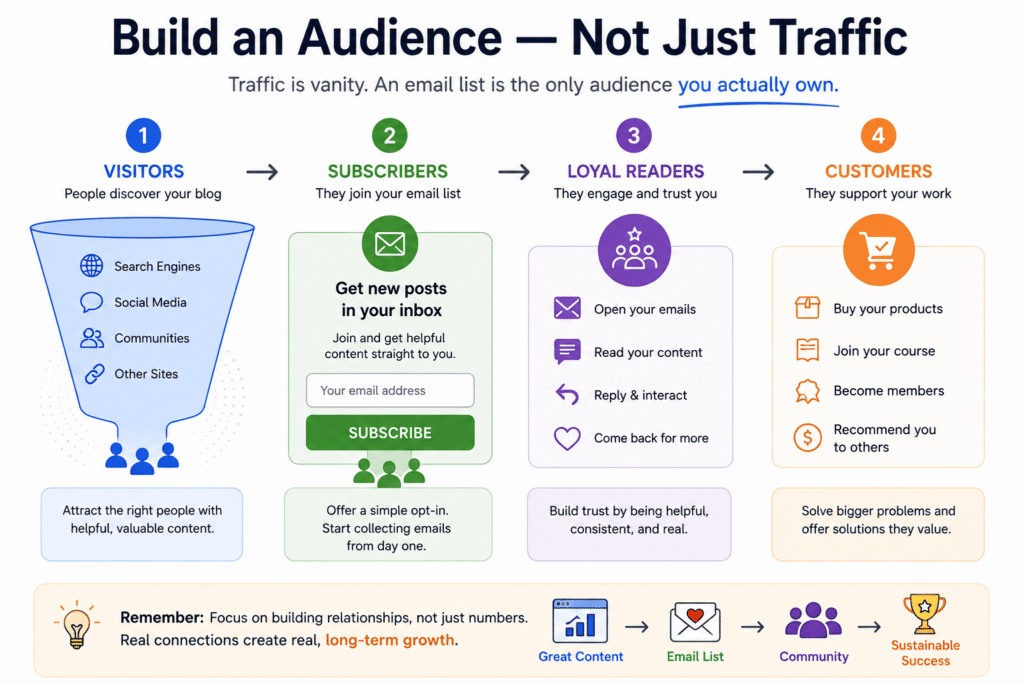
Start collecting emails from day one. Even if it’s just a simple “get my new posts by email” form. ConvertKit (now Kit) is still one of the cleanest options for bloggers. Mailchimp works too, though their free plan has gotten more restrictive. Beehiiv is worth considering if your blog leans newsletter-heavy.
Social media matters, but be selective. Trying to be everywhere is a trap. Pick one platform where your audience actually hangs out and go deep on it. For most niches in 2026, that’s LinkedIn, Reddit, or a specific community forum — not TikTok, unless your content genuinely translates to short video.
Something that’s worked better than I expected: replying to every comment and email for the first six months. It sounds obvious, but most bloggers don’t do it. The readers who get a real reply become your most loyal fans — and often your best source of future content ideas.
Common mistakes that slow people down
- Spending months on design before publishing a single post. No one cares about your header font until there’s content worth reading.
- Writing for search engines instead of humans. Posts stuffed with keywords and no real insight rank poorly and drive people away.
- Going too broad. “Travel blog” is not a niche. “Solo travel for introverts over 40” is a niche.
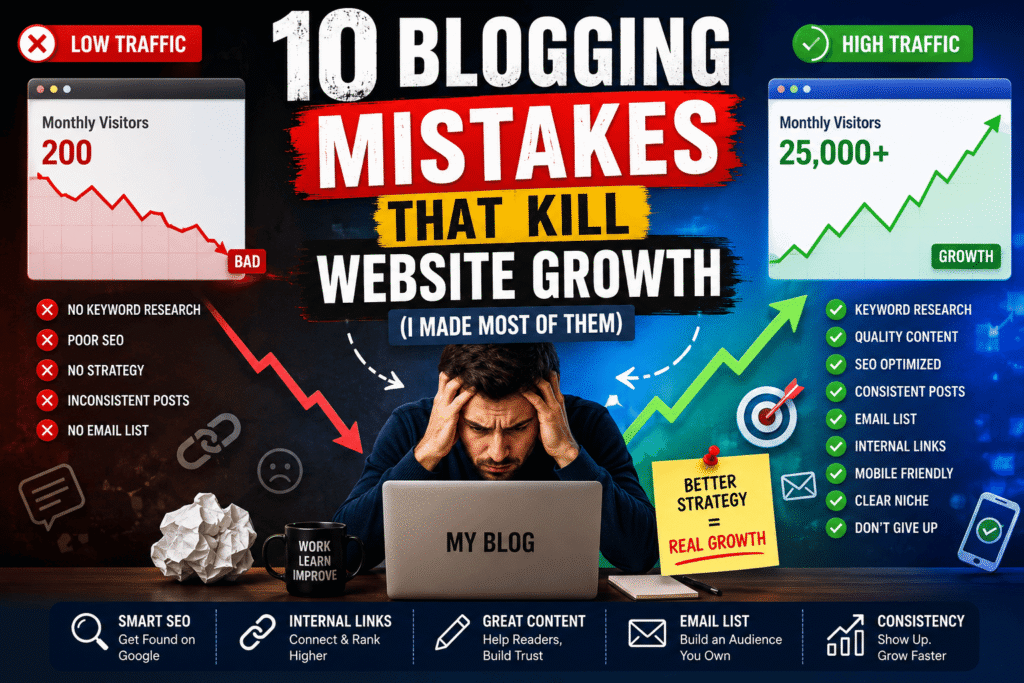
- Expecting results in 90 days. Most blogs take 12–18 months to get meaningful traction. The ones that “blow up overnight” usually have years of groundwork behind them.
- Trying to monetize too early. Ads on a blog with 200 monthly visitors earn almost nothing and signal to readers that you care more about money than them.
When does a blog make money?
This varies wildly, but here’s a realistic picture from people I’ve talked to and my own experience. Display ads (via Mediavine or Ezoic) typically become worthwhile at 10,000–50,000 monthly sessions. Affiliate income can start much earlier if you’re in a commercial niche and writing review or comparison content. Sponsored posts require an engaged audience more than raw traffic numbers.
The fastest path to monetization isn’t ads — it’s selling something of your own. A digital product, a course, a template, even a paid newsletter. But that only works once you have trust, which takes content and time.
Patience isn’t optional here. It’s the actual strategy.
The thing nobody talks about enough
Consistency beats everything. Not consistency in the “post every Tuesday at 9am” sense — but consistency in showing up, improving, and not quitting after the first three months when traffic is still minimal.
The bloggers who succeed aren’t necessarily the best writers or the smartest marketers. They’re the ones who kept going when there was no audience yet, refined their approach based on what was actually working, and trusted that compounding effort eventually pays off.
Start small. Publish something imperfect. Learn from your readers. The blog you have in two years will be almost unrecognizable compared to the one you start today — and that’s exactly how it should be.